Static vs Dynamic Website: Which One Should You Choose?
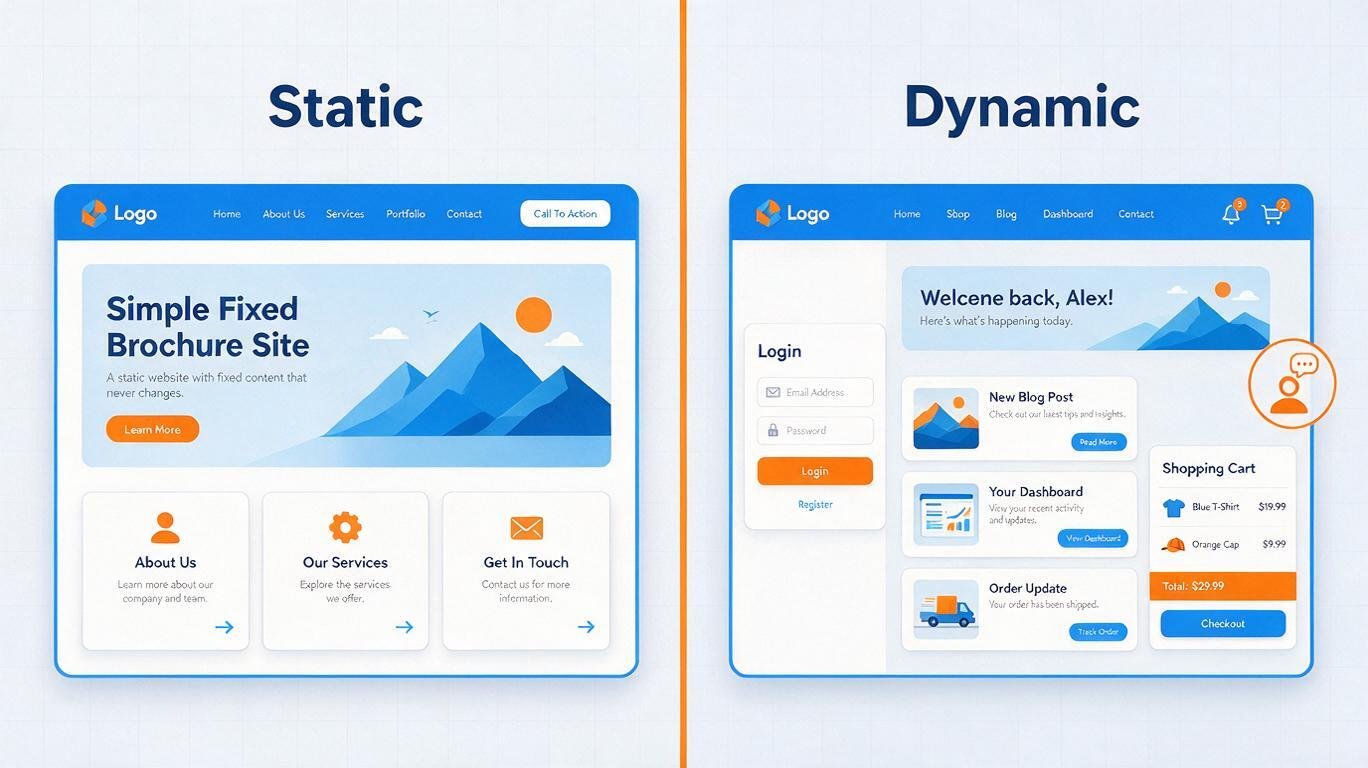
One of the first real decisions you'll face when building a website isn't about colours or fonts, it's about how the site actually works behind the scenes. Should it be static, a fixed set of pages that look the same for every visitor, or dynamic, a site that generates content on the fly and can be updated without touching a single line of code? Both are valid choices, and the right one depends entirely on what your business actually needs. This guide breaks down the difference in plain terms so you can make that call with confidence.
What Is a Static Website?
A static website is built from fixed HTML, CSS, and JavaScript files. Every visitor sees exactly the same page, and nothing changes unless a developer edits the underlying code and re-uploads it. Think of it as a digital brochure: clean, simple, and built to present information rather than react to the user.
Static sites are typically used for portfolios, small business showcases, landing pages, and company profile sites where the content doesn't change often, things like your services, your team, your contact details.
What Is a Dynamic Website?
A dynamic website generates its pages in real time, usually by pulling content from a database. This means the content can change based on who is viewing it, what they search for, or what admin updates were made, all without anyone touching the code. Blogs, online stores, booking systems, and membership platforms are all dynamic by nature, because their content is constantly changing.
Most dynamic websites come with an admin panel or CMS (content management system), letting a non-technical person add a blog post, update a price, or upload a new product without needing a developer every time.
Side-by-Side Comparison
| Factor | Static Website | Dynamic Website |
|---|---|---|
| Content Updates | Requires a developer to edit code | Update anytime via admin panel |
| Development Cost | Lower upfront cost | Higher upfront cost |
| Speed | Very fast, minimal server work | Slightly slower, depends on database |
| Best For | Portfolios, brochure sites | Blogs, e-commerce, membership sites |
| Scalability | Limited, pages added manually | Easily scales with more pages/content |
| Interactivity | Minimal, mostly one-way content | Forms, logins, carts, personalization |
| Maintenance | Low, rarely needs attention | Ongoing, needs updates & backups |
Advantages of a Static Website
- Loads extremely fast since there's no database lookup involved.
- Lower cost to build and host, ideal for tighter budgets.
- Fewer security risks, since there's no database or login system to target.
- Simple to maintain once it's live, with little ongoing upkeep.
Advantages of a Dynamic Website
- Content can be updated instantly without any coding knowledge.
- Supports interactive features like logins, carts, forms, and search.
- Scales easily as your business grows, add pages or products anytime.
- Enables personalisation, showing different content to different visitors.
Which One Should You Choose?
Choose a Static Website If:
- You run a small business with services or information that rarely changes.
- You need a simple, fast, professional online presence, like a portfolio or company profile.
- Your budget is limited and you want to keep hosting and maintenance costs low.
- You don't need customers to log in, place orders, or interact with the site directly.
Choose a Dynamic Website If:
- You plan to publish regular content, such as blog posts, news, or updates.
- You're running an online store or need customers to book, log in, or pay online.
- You expect the site to grow significantly over time, with more pages and features.
- You want a non-technical team member to be able to update content independently.
Can You Start Static and Move to Dynamic Later?
Yes, and many businesses do exactly this. Starting with a static site keeps early costs low while you validate your business and build an audience. Once you need blogging, e-commerce, or regular content updates, you can migrate to a dynamic setup. It does involve some rebuilding, so if you already know you'll need those features soon, it can be more efficient to start dynamic from day one.
Final Thoughts
Neither option is universally better, they simply serve different needs. A static website is lean, fast, and cost-effective for businesses with straightforward, rarely-changing content. A dynamic website offers flexibility, interactivity, and room to grow, at the cost of a higher initial investment and a bit more upkeep. The right choice comes down to how often your content changes and how much your site needs to do beyond simply being seen.
Need help with a project like this?
Tell us your requirement — we reply with a scope, timeline and quote within 24 hours.
Get a Free Quote →