Professional Clinic & Pathology ERP Software
AjonTec Clinic & Pathology ERP is a digital management solution designed to help clinics, diagnostic centers, pathology laboratories, and other eligible healthcare organizations organize their administrative and operational workflows through a centralized system.
The system can bring patient registration, appointments, doctors, laboratory tests, sample management, billing, reports, prescriptions, staff, and other supported operations into one structured platform. The exact modules and workflows depend on the healthcare organization's requirements, selected plan, technical architecture, and applicable implementation scope.
What Is Included
- Patient registration and management
- Doctor and staff management
- Appointment management
- Patient visit records
- Laboratory test management
- Sample collection and tracking
- Pathology report management
- Billing and payment records
- Prescription management where applicable
- Patient history management
- Dashboard and operational reports
- User roles and access permissions
Patient Management
The ERP can maintain structured patient records required for the configured healthcare workflow. Depending on the implementation, information may include patient identification details, contact information, visit records, test information, reports, billing information, and other approved data.
Healthcare organizations are responsible for determining what patient information is necessary to collect and for ensuring that collection, use, storage, retention, access, and disclosure are handled according to applicable laws, professional requirements, and organizational policies.
Patient Registration
The patient registration module can help staff create and manage patient records and assign appropriate identifiers for future visits, appointments, laboratory services, or other supported healthcare workflows.
Appointment Management
The system can provide appointment management functionality for scheduling patient visits with doctors, specialists, or other applicable healthcare professionals. Depending on the configuration, appointments may include date, time, doctor, department, patient, status, and other relevant information.
Doctor & Staff Management
Administrators can maintain information about doctors, technicians, reception staff, administrators, and other authorized personnel. User permissions can be configured according to the responsibilities assigned to each role.
OPD / Consultation Management
Where applicable, the ERP can support outpatient consultation workflows by connecting patient visits with doctors, appointment records, consultation information, prescriptions, billing, or other approved modules.
The software is intended to support administrative and information-management processes. It does not independently provide medical diagnosis, treatment advice, or clinical decision-making.
Pathology & Laboratory Management
The pathology module can help laboratories manage available tests, patient test requests, sample information, laboratory processing workflows, results, and reports according to the laboratory's configured processes.
Test Management
Authorized users can manage supported laboratory test information such as test names, categories, parameters, reference information, pricing, sample requirements, and other applicable fields.
Reference ranges, test parameters, units, interpretations, and other clinical information should be configured and reviewed by appropriately qualified healthcare or laboratory professionals.
Sample Collection & Tracking
Where enabled, the system can record sample collection information and associate samples with patients and requested laboratory tests. Sample statuses can be managed according to the laboratory's approved workflow.
Laboratory Report Management
The ERP can support the preparation, storage, review, and delivery of laboratory reports according to the configured workflow. Authorized personnel may be able to enter or verify applicable test results before reports are finalized.
Laboratory results are clinical information and should be reviewed, verified, and authorized by appropriately qualified personnel before being released to patients or other authorized recipients.
Billing & Payment Management
The system can manage applicable consultation, laboratory, diagnostic, or other service charges and maintain payment records according to the organization's billing process.
Where online payment functionality is enabled, payment processing is handled through the selected payment service provider and remains subject to its terms, verification requirements, fees, availability, and technical limitations.
Prescription Management
Where included, the system may provide functionality for authorized healthcare professionals to record or manage prescription-related information.
Prescription and medication decisions must be made by appropriately qualified healthcare professionals. The software should not be used as a substitute for professional medical judgment.
Patient History
The system can organize supported historical information associated with a patient, such as previous visits, laboratory tests, reports, billing records, or other approved healthcare information.
Access to patient information should be restricted to authorized personnel based on legitimate healthcare or administrative requirements.
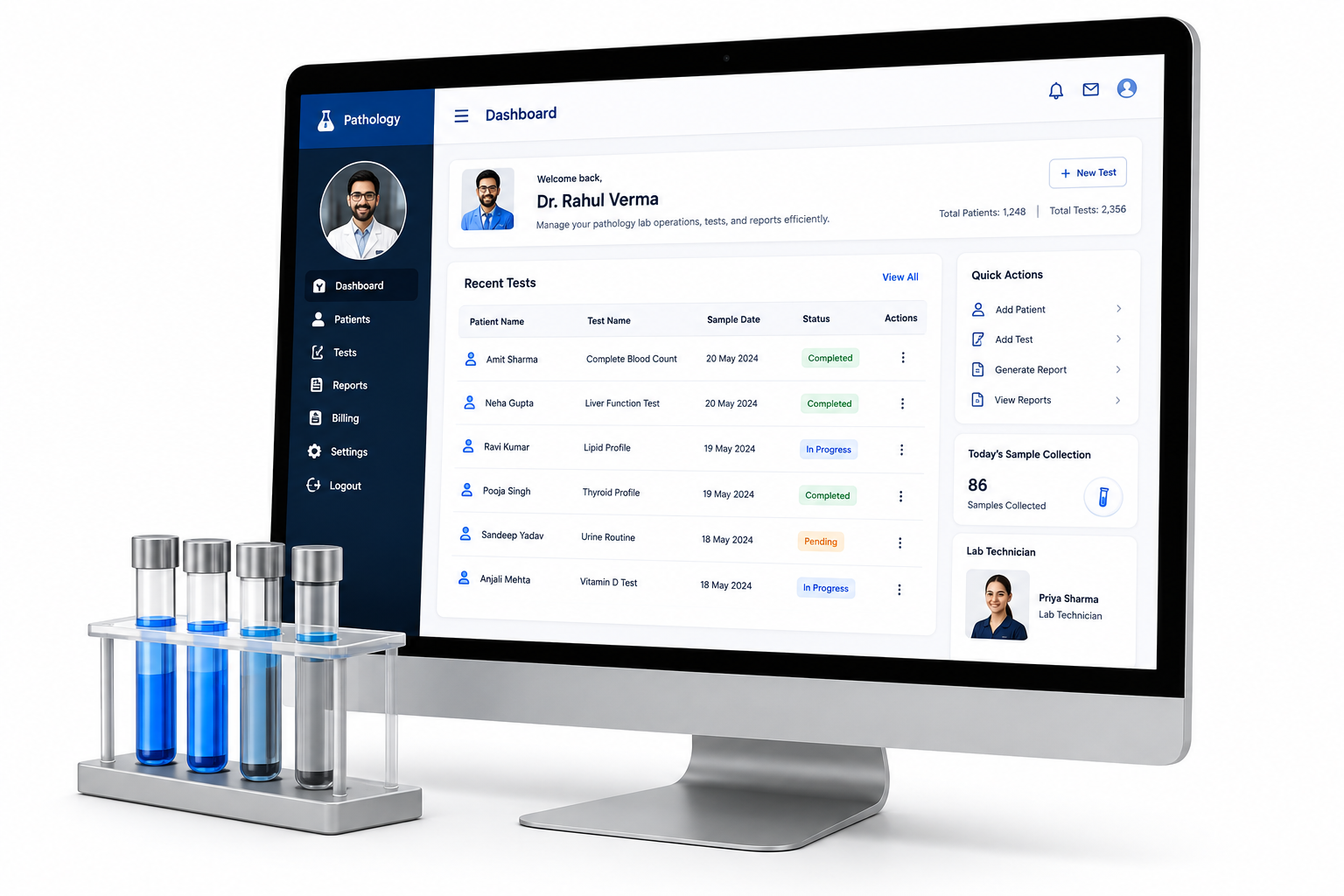
Dashboard & Reports
The ERP dashboard can provide authorized users with operational summaries and reports based on recorded information. Depending on the configured modules, reports may include appointments, patients, tests, samples, reports, billing, payments, and other administrative information.
Typical Clinic & Pathology ERP Modules
- Admin Dashboard
- Patient Registration
- Patient Management
- Doctor Management
- Staff Management
- Appointment Management
- OPD / Visit Management
- Prescription Management where applicable
- Laboratory Test Management
- Sample Collection Management
- Sample Tracking
- Result Entry
- Pathology Report Management
- Billing Management
- Payment Management
- Patient History
- Reports
- User Roles & Permissions
Additional modules such as pharmacy management, inpatient management, bed management, radiology management, insurance or TPA integration, advanced laboratory automation, biometric integration, mobile applications, or external device integrations may require additional configuration or development.
Suitable Healthcare Organizations
- Clinics
- Pathology laboratories
- Diagnostic centers
- Medical laboratories
- Doctor consultation centers
- Multi-specialty clinics
- Small healthcare facilities
- Healthcare service organizations
Benefits of Clinic & Pathology ERP
- Centralizes patient and operational information
- Organizes appointment and patient workflows
- Helps manage laboratory tests and samples
- Provides structured report management
- Supports healthcare billing and payment records
- Reduces dependence on fragmented manual records
- Provides management dashboards and reports
- Supports controlled access to healthcare information
- Provides a foundation for further healthcare digitalization
Healthcare Data Privacy & Security
Clinic and pathology systems may process highly sensitive personal and health-related information. Depending on the configured functionality, this may include patient identity information, contact details, medical or diagnostic information, laboratory results, prescriptions, billing information, and related records.
The healthcare organization operating the system is responsible for determining the applicable legal and regulatory requirements for collection, processing, storage, access, retention, correction, disclosure, and deletion of patient information.
Appropriate technical safeguards can be implemented based on the agreed system architecture, including authentication, role-based access control, protected communication, access restrictions, secure data handling, backups, and other applicable security measures.
No internet-connected software system can be guaranteed to be completely immune from vulnerabilities, unauthorized access, data loss, cyberattacks, or other security risks. Healthcare organizations should maintain appropriate security, backup, access-control, and incident-management procedures.
User Roles & Access Control
The ERP can support different user roles such as administrator, doctor, laboratory technician, receptionist, billing staff, manager, or other authorized users. Permissions can be configured to limit access to information and functions based on assigned responsibilities.
Access to patient and diagnostic information should be limited to authorized users with a legitimate purpose, following the healthcare organization's internal privacy and security policies.
Laboratory Quality & Result Verification
The software can support laboratory information workflows, but it does not replace laboratory quality-control procedures, professional verification, equipment calibration, clinical protocols, or applicable regulatory requirements.
Laboratory personnel and authorized healthcare professionals remain responsible for verifying the accuracy and validity of results before reports are finalized and released.
Clinic & Pathology ERP Implementation Process
- Requirement Analysis: The clinic or laboratory's patient workflow, appointments, tests, samples, reports, billing, users, and operational requirements are reviewed.
- Workflow Planning: Patient registration, consultation, laboratory, sample, report, billing, and user workflows are mapped according to the approved process.
- System Configuration: Doctors, staff, departments, tests, services, charges, users, permissions, and other applicable settings are configured.
- Data Preparation: Existing records may be prepared for migration where technically feasible and where data migration is included in the agreed scope.
- Module Setup: Applicable patient, appointment, laboratory, billing, report, and administrative modules are configured.
- User & Permission Setup: Appropriate access levels are configured for administrators, doctors, technicians, reception staff, billing users, and other authorized users.
- Testing: Patient registration, appointments, tests, samples, results, reports, billing, permissions, and other agreed workflows are tested.
- Deployment: The ERP is deployed or activated in the agreed environment after completion of the required technical configuration.
Pricing
Starting Price: ₹499/month
The displayed price represents the currently listed AjonTec starting service plan. Final pricing may vary depending on the number of users, doctors, branches, laboratory tests, modules, data volume, integrations, report requirements, customization, hosting, storage, patient portal requirements, and other project-specific needs.
Applicable taxes, hosting, SMS or communication charges, payment gateway fees, laboratory device integrations, third-party APIs, cloud services, premium features, additional storage, and other external costs may be charged separately unless specifically included in the selected plan or quotation.
Important Legal & Healthcare Information
- The healthcare organization is responsible for the accuracy of patient, laboratory, billing, prescription, and other information entered into the system.
- Medical diagnosis, treatment decisions, prescriptions, and clinical judgments must be made by appropriately qualified healthcare professionals.
- AjonTec provides software and technical services and does not provide medical diagnosis, treatment, or clinical advice through the software.
- Healthcare organizations remain responsible for complying with applicable healthcare, privacy, data protection, medical, laboratory, tax, billing, and other legal or regulatory requirements.
- Laboratory results should be verified and authorized by appropriately qualified personnel before being released.
- Third-party payment, communication, laboratory device, cloud, or other integrations are subject to their respective terms, availability, and charges.
- Features outside the agreed scope may require additional charges.
Why Choose AjonTec?
AjonTec focuses on developing structured digital solutions that help healthcare organizations organize their administrative and operational workflows. The Clinic & Pathology ERP can be configured around patient management, appointments, laboratory operations, billing, reports, staff access, and other approved requirements.
The objective is to provide authorized healthcare and administrative personnel with organized access to relevant information while supporting appropriate workflow control and data security.
Get Started
To implement a Clinic & Pathology ERP, provide your organization type, number of doctors and staff, expected patient volume, laboratory services, test categories, sample workflow, report requirements, billing process, user roles, integrations, and any existing data that needs to be migrated. AjonTec can review the requirements and recommend the appropriate ERP configuration.
What You Get
- Patient registration and management
- Doctor and staff management
- Appointment management
- Patient visit records
- Laboratory test management
- Sample collection and tracking
Frequently Asked Questions
What is Clinic & Pathology ERP?
Clinic & Pathology ERP is a centralized software solution designed to help clinics, pathology laboratories, diagnostic centers, and other eligible healthcare organizations manage patients, appointments, laboratory tests, samples, reports, billing, and related administrative workflows.
Can the ERP manage patient records?
Yes. The system can maintain supported patient information, visits, laboratory records, reports, billing information, and other configured healthcare records.
Can patients book appointments through the system?
Appointment management can be provided for scheduling patient visits. Online patient self-booking can also be developed where included in the selected implementation and technical scope.
Can the system manage pathology tests and samples?
Yes. The pathology module can support test management, sample collection, sample tracking, result entry, and report workflows according to the laboratory's configured process.
Can laboratory reports be generated through the ERP?
Yes. The system can support report preparation and management. Laboratory results should be reviewed and authorized by appropriately qualified personnel before being released.
Can the ERP manage clinic and laboratory billing?
Yes. Applicable consultation, laboratory, diagnostic, and other service charges can be managed through the billing module according to the organization's configured workflow.
Can doctors and laboratory technicians have different access?
Yes. Role-based permissions can be configured so that doctors, technicians, receptionists, billing staff, administrators, and other users receive access appropriate to their responsibilities.
What is the starting price of Clinic & Pathology ERP?
The listed starting price is **₹499/month**. Actual pricing may vary based on users, doctors, branches, laboratory modules, integrations, data migration, customization, storage, and other requirements.
Does the ERP provide medical diagnosis or treatment recommendations?
No. The ERP is a software and management tool. It does not replace a qualified healthcare professional's clinical judgment, diagnosis, treatment, or prescription decisions.
Is patient information secure in the ERP?
Appropriate authentication, access control, secure communication, and other technical safeguards can be implemented based on the system architecture. Healthcare organizations must also maintain appropriate privacy, security, backup, retention, and access-control procedures, and no internet-connected system can be guaranteed to be completely free from security risks.